
Auto claim fault determination: no-fault vs at-fault states
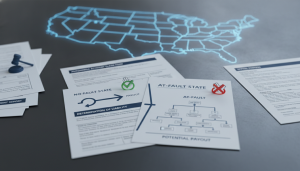
Disclaimer: This article is informational and does not constitute legal or insurance advice. Insurance claim rules (statute of limitations, denial appeal deadlines, bad faith elements, ERISA procedures) vary by state and policy specifics. For your specific claim or denial, consult a qualified attorney licensed in your state, file a complaint with your state Department of Insurance, or contact the ABA Lawyer Referral Service. Imagine you are driving through a busy intersection in early 2026 when another vehicle suddenly merges into your lane, causing a collision. In the immediate aftermath, your primary concerns are safety and vehicle repairs, but a high-stakes legal and financial process is already beginning: the determination of fault. As of 2026, the landscape of auto insurance remains a complex patchwork of state-specific regulations that dictate who pays for damages, how much you can recover, and whether you have the right to take a case to court. Understanding the nuances of auto claim fault determination is not just a matter of academic interest; it is the deciding factor in whether your insurance premiums skyrocket or whether you receive a settlement that covers your medical bills and lost wages. The process of assigning blame in a car accident is rarely as straightforward as one driver admitting “it was my fault.” Insurance companies, guided by state statutes and the National Association of Insurance Commissioners (NAIC) standards, employ sophisticated methods to evaluate evidence and apply negligence laws. Whether you live in a “no-fault” state or an “at-fault” (tort) state, the outcome of your claim hinges on how these rules are applied to your specific situation. This guide will navigate the critical differences between these systems in 2026, explain the legal standards of negligence, and provide actionable steps for disputing a determination that you believe is unfair. How Fault is Determined in a Car Accident In 2026, the process of auto claim fault determination remains a multi-layered investigation conducted primarily by insurance adjusters. When you file a claim, the insurance companies involved will assign an adjuster to review the facts. These professionals do not merely look at the damage; they analyze police reports, witness statements, weather conditions, and increasingly in 2026, digital data from vehicle “black boxes” (Event Data Recorders) and telematics. The goal is to determine which driver’s actions—or lack thereof—violated the standard of care expected on the road. For a deeper dive into the immediate steps following a collision, you …